
| Concept | Formula | Key Note |
| Factorial Notation | $n! = n(n – 1)(n – 2) … 3 \cdot 2 \cdot 1$ | $0! = 1$ |
| Permutations ($n$ things, $r$ at a time) | $^nP_r = \frac{n!}{(n – r)!}$ | Order matters (e.g., $ab \neq ba$) |
| Permutations (all $n$ things) | $n!$ | Taken all at a time |
| Permutations (with identical items) | $\frac{n!}{(p_1!)(p_2!)…(p_r!)}$ | Where $p_1, p_2…$ are alike items |
| Combinations ($n$ things, $r$ at a time) | $^nC_r = \frac{n!}{(r!)(n – r)!}$ | Order does not matter (e.g., $ab = ba$) |
| Property | Formula / Result |
| Symmetry Property | $^nC_r = ^nC_{(n – r)}$ |
| Full Selection | $^nC_n = 1$ |
| Zero Selection | $^nC_0 = 1$ |
| Type | Problem | Calculation | Result |
| Factorial | $4!$ | $4 \times 3 \times 2 \times 1$ | 24 |
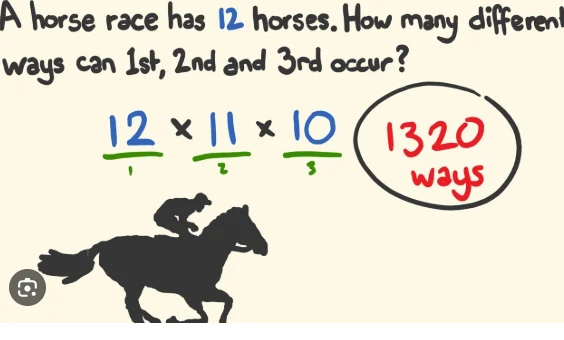
| Permutation | $^6P_2$ | $6 \times 5$ | 30 |
| Permutation | $^7P_3$ | $7 \times 6 \times 5$ | 210 |
| Combination | $^{11}C_4$ | $\frac{11 \times 10 \times 9 \times 8}{4 \times 3 \times 2 \times 1}$ | 330 |
| Combination | $^{16}C_{13}$ | same as $^{16}C_3 = \frac{16 \times 15 \times 14}{3 \times 2 \times 1}$ | 560 |
1. Factorial Notation
Let n be a positive integer. Then, factorial n, denoted n! is defined as:
$n! = n(n – 1)(n – 2) … 3 \cdot 2 \cdot 1$
- We define $0! = 1$.
- $4! = (4 \times 3 \times 2 \times 1) = 24$.
- $5! = (5 \times 4 \times 3 \times 2 \times 1) = 120$.
2. Permutations
The different arrangements of a given number of things by taking some or all at a time, are called permutations.
- All permutations made with the letters a, b, c by taking two at a time are (ab, ba, ac, ca, bc, cb).
- All permutations made with the letters a, b, c taking all at a time are: (abc, acb, bac, bca, cab, cba).
3. Number of Permutations
Number of all permutations of n things, taken r at a time, is given by:
$^nP_r = n(n – 1)(n – 2) … (n – r + 1) = \frac{n!}{(n – r)!}$
- $^6P_2 = (6 \times 5) = 30$.
- $^7P_3 = (7 \times 6 \times 5) = 210$.
- Cor. number of all permutations of n things, taken all at a time = $n!$.
4. An Important Result
If there are n subjects of which $p_1$ are alike of one kind; $p_2$ are alike of another kind; $p_3$ are alike of third kind and so on, the number of permutations is:
$= \frac{n!}{(p_1!)(p_2!)…..(p_r!)}$
5. Combinations
Each of the different groups or selections which can be formed by taking some or all of a number of objects is called a combination.
- Selection of two out of three boys A, B, C: AB, BC, and CA. (Note: AB and BA are the same selection).
- All combinations formed by a, b, c taking two at a time: ab, bc, ca.
- The only combination of a, b, c taken all at a time: abc.
6. Number of Combinations
The number of all combinations of n things, taken r at a time is:
$^nC_r = \frac{n!}{(r!)(n – r)!} = \frac{n(n – 1)(n – 2) … \text{to } r \text{ factors}}{r!}$
- Note 1: $^nC_n = 1$ and $^nC_0 = 1$.
- Note 2: $^nC_r = ^nC_{(n – r)}$.
- $^{11}C_4 = \frac{11 \times 10 \times 9 \times 8}{4 \times 3 \times 2 \times 1} = 330$.
- $^{16}C_{13} = ^{16}C_3 = \frac{16 \times 15 \times 14}{3 \times 2 \times 1} = 560$.