
| Category | Icon | Key Results & Properties |
| Triangles | 🔺 | • Sum of angles is 180°. • Sum of any two sides > third side. • Pythagoras Theorem: $a^2 + b^2 = c^2$ (for right-angled triangles). • Centroid: Point where medians meet; divides medians in 2:1 ratio. • Median divides a triangle into two equal areas. |
| Quadrilaterals | ▱ | • Parallelogram diagonals bisect each other. • Square/Rhombus diagonals bisect at 90°. • Rectangle diagonals are equal. • Rectangle has the greatest area among parallelograms of given sides. |
| Shape | Icon | Area Formula | Perimeter / Other |
| Rectangle | ▮ | $\text{Length} \times \text{Breadth}$ | $2(\text{Length} + \text{Breadth})$ |
| Square | ◼ | $(\text{side})^2$ or $\frac{1}{2}(\text{diagonal})^2$ | $4 \times \text{side}$ |
| Triangle (General) | △ | $\frac{1}{2} \times \text{Base} \times \text{Height}$ | Heron’s: $\sqrt{s(s-a)(s-b)(s-c)}$ |
| Equilateral Triangle | ▽ | $\frac{\sqrt{3}}{4} \times (\text{side})^2$ | Inradius = $\frac{a}{2\sqrt{3}}$; Circumradius = $\frac{a}{\sqrt{3}}$ |
| Circle | ◯ | $\pi R^2$ | Circumference = $2\pi R$ |
| Parallelogram | ▱ | $\text{Base} \times \text{Height}$ | – |
| Rhombus | 💠 | $\frac{1}{2} \times (\text{Product of diagonals})$ | – |
| Trapezium | ⏢ | $\frac{1}{2} \times (\text{sum of parallel sides}) \times \text{height}$ | – |
| 4 Walls of a Room | 🏠 | $2(\text{Length} + \text{Breadth}) \times \text{Height}$ | – |
| Component | Icon | Formula |
| Length of Arc | 弧 | $\frac{2\pi R\theta}{360}$ |
| Area of Sector | 🍕 | $\frac{1}{2}(\text{arc} \times R)$ or $\frac{\pi R^2\theta}{360}$ |
| Semi-circle | ◑ | Area = $\frac{\pi R^2}{2}$ |
📐 Fundamental Concepts: Triangles & Quadrilaterals
| Category | Icon | Key Results & Properties |
| Triangles | 🔺 | • Sum of angles is 180°. • Sum of any two sides > third side. • Pythagoras Theorem: $a^2 + b^2 = c^2$ (for right-angled triangles). • Centroid: Point where medians meet; divides medians in 2:1 ratio. • Median divides a triangle into two equal areas. |
| Quadrilaterals | ▱ | • Parallelogram diagonals bisect each other. • Square/Rhombus diagonals bisect at 90°. • Rectangle diagonals are equal. • Rectangle has the greatest area among parallelograms of given sides. |
📝 Important Area & Perimeter Formulas
| Shape | Icon | Area Formula | Perimeter / Other |
| Rectangle | ▮ | $\text{Length} \times \text{Breadth}$ | $2(\text{Length} + \text{Breadth})$ |
| Square | ◼ | $(\text{side})^2$ or $\frac{1}{2}(\text{diagonal})^2$ | $4 \times \text{side}$ |
| Triangle (General) | △ | $\frac{1}{2} \times \text{Base} \times \text{Height}$ | Heron’s: $\sqrt{s(s-a)(s-b)(s-c)}$ |
| Equilateral Triangle | ▽ | $\frac{\sqrt{3}}{4} \times (\text{side})^2$ | Inradius = $\frac{a}{2\sqrt{3}}$; Circumradius = $\frac{a}{\sqrt{3}}$ |
| Circle | ◯ | $\pi R^2$ | Circumference = $2\pi R$ |
| Parallelogram | ▱ | $\text{Base} \times \text{Height}$ | – |
| Rhombus | 💠 | $\frac{1}{2} \times (\text{Product of diagonals})$ | – |
| Trapezium | ⏢ | $\frac{1}{2} \times (\text{sum of parallel sides}) \times \text{height}$ | – |
| 4 Walls of a Room | 🏠 | $2(\text{Length} + \text{Breadth}) \times \text{Height}$ | – |
🥧 Circles, Sectors, and Arcs
| Component | Icon | Formula |
| Length of Arc | 弧 | $\frac{2\pi R\theta}{360}$ |
| Area of Sector | 🍕 | $\frac{1}{2}(\text{arc} \times R)$ or $\frac{\pi R^2\theta}{360}$ |
| Semi-circle | ◑ | Area = $\frac{\pi R^2}{2}$ |
Note: For a triangle, $s$ represents the semi-perimeter, calculated as $s = \frac{a+b+c}{2}$.
FUNDAMENTAL CONCEPTS
Results on Triangles:
Contents
- Sum of the angles of a triangle is 180°.
- The sum of any two sides of a triangle is greater than the third side.
- Pythagoras Theorem: In a right-angled triangle, $(\text{Hypotenuse})^2 = (\text{Base})^2 + (\text{Height})^2$.
- The line joining the mid-point of a side of a triangle to the opposite vertex is called the median.
- The point where the three medians of a triangle meet, is called centroid. The centroid divided each of the medians in the ratio 2 : 1.
- In an isosceles triangle, the altitude from the vertex bisects the base.
- The median of a triangle divides it into two triangles of the same area.
- The area of the triangle formed by joining the mid-points of the sides of a given triangle is one-fourth of the area of the given triangle.
Results on Quadrilaterals:
- The diagonals of a parallelogram bisect each other.
- Each diagonal of a parallelogram divides it into triangles of the same area.
- The diagonals of a rectangle are equal and bisect each other.
- The diagonals of a square are equal and bisect each other at right angles.
- The diagonals of a rhombus are unequal and bisect each other at right angles.
- A parallelogram and a rectangle on the same base and between the same parallels are equal in area.
- Of all the parallelogram of given sides, the parallelogram which is a rectangle has the greatest area.
IMPORTANT FORMULAE
- Area of a rectangle = $(\text{Length} \times \text{Breadth})$.
- $\text{Length} = \frac{\text{Area}}{\text{Breadth}}$ and $\text{Breadth} = \frac{\text{Area}}{\text{Length}}$.
- Perimeter of a rectangle = $2(\text{Length} + \text{Breadth})$.
- Area of a square = $(\text{side})^2 = \frac{1}{2}(\text{diagonal})^2$.
- Area of 4 walls of a room = $2(\text{Length} + \text{Breadth}) \times \text{Height}$.
- Triangle Formulas:
- Area of a triangle = $\frac{1}{2} \times \text{Base} \times \text{Height}$.
- Area of a triangle = $\sqrt{s(s – a)(s – b)(s – c)}$ where $a, b, c$ are the sides of the triangle and $s = \frac{1}{2}(a + b + c)$.
- Area of an equilateral triangle = $\frac{\sqrt{3}}{4} \times (\text{side})^2$.
- Radius of incircle of an equilateral triangle of side $a$ = $\frac{a}{2\sqrt{3}}$.
- Radius of circumcircle of an equilateral triangle of side $a$ = $\frac{a}{\sqrt{3}}$.
- Radius of incircle of a triangle of area $\Delta$ and semi-perimeter $s$: $r = \frac{\Delta}{s}$.
- Other Quadrilaterals:
- Area of parallelogram = $(\text{Base} \times \text{Height})$.
- Area of a rhombus = $\frac{1}{2} \times (\text{Product of diagonals})$.
- Area of a trapezium = $\frac{1}{2} \times (\text{sum of parallel sides}) \times \text{distance between them}$.
- Circle Formulas:
- Area of a circle = $\pi R^2$, where $R$ is the radius.
- Circumference of a circle = $2\pi R$.
- Length of an arc = $\frac{2\pi R\theta}{360}$, where $\theta$ is the central angle.
- Area of a sector = $\frac{1}{2}(\text{arc} \times R) = \frac{\pi R^2\theta}{360}$.
- Semi-circle Formulas:
- Circumference of a semi-circle = $\pi R$.
- Area of semi-circle = $\frac{\pi R^2}{2}$.
| Shape | Volume (V) | Surface Area (SA) | Key Properties |
| 🧊 Cuboid | $l \times b \times h$ | $2(lb + bh + lh)$ | Diagonal: $\sqrt{l^2 + b^2 + h^2}$ |
| 🎲 Cube | $a^3$ | $6a^2$ | Diagonal: $\sqrt{3}a$ |
| 🧪 Cylinder | $\pi r^2 h$ | $2\pi r(h + r)$ | Curved Area: $2\pi rh$ |
| 🍦 Cone | $\frac{1}{3} \pi r^2 h$ | $\pi r(l + r)$ | Slant Height ($l$): $\sqrt{h^2 + r^2}$ |
| 🏀 Sphere | $\frac{4}{3} \pi r^3$ | $4 \pi r^2$ | $r$ is the only variable |
| 🥣 Hemisphere | $\frac{2}{3} \pi r^3$ | $3 \pi r^2$ | Curved Area: $2 \pi r^2$ |
Quick Conversion Tips
- Capacity: $1 \text{ liter} = 1000 \text{ cm}^3$
- Pi ($\pi$): Usually taken as $\frac{22}{7}$ or $3.14$ for calculations.
- Units: Volume is always in cubic units (e.g., $\text{cm}^3$, $\text{m}^3$), while Surface Area is in square units (e.g., $\text{cm}^2$, $\text{m}^2$).
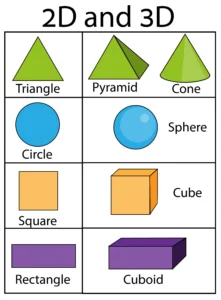
| Shape | Formula Type | Formula Expression |
| 1. CUBOID | 1. Volume | $(l \times b \times h)$ cubic units. |
| (len = $l$, br = $b$, ht = $h$) | 2. Surface area | $2(lb + bh + lh)$ sq. units. |
| 3. Diagonal | $\sqrt{l^2 + b^2 + h^2}$ units. | |
| 2. CUBE | 1. Volume | $a^3$ cubic units. |
| (each edge = $a$) | 2. Surface area | $6a^2$ sq. units. |
| 3. Diagonal | $\sqrt{3}a$ units. | |
| 3. CYLINDER | 1. Volume | $(\pi r^2 h)$ cubic units. |
| (rad = $r$, ht = $h$) | 2. Curved surface area | $(2 \pi rh)$ sq. units. |
| 3. Total surface area | $2 \pi r(h + r)$ sq. units. | |
| 4. CONE | 1. Slant height ($l$) | $\sqrt{h^2 + r^2}$ units. |
| (rad = $r$, ht = $h$) | 2. Volume | $\frac{1}{3} \pi r^2 h$ cubic units. |
| 3. Curved surface area | $(\pi rl)$ sq. units. | |
| 4. Total surface area | $(\pi rl + \pi r^2)$ sq. units. | |
| 5. SPHERE | 1. Volume | $\frac{4}{3} \pi r^3$ cubic units. |
| (rad = $r$) | 2. Surface area | $(4 \pi r^2)$ sq. units. |
| 6. HEMISPHERE | 1. Volume | $\frac{2}{3} \pi r^3$ cubic units. |
| (rad = $r$) | 2. Curved surface area | $(2 \pi r^2)$ sq. units. |
| 3. Total surface area | $(3 \pi r^2)$ sq. units. |
Note: $1 \text{ litre} = 1000 \text{ cm}^3$
1. CUBOID
Let length = $l$, breadth = $b$ and height = $h$ units. Then,
- Volume = $(l \times b \times h)$ cubic units.
- Surface area = $2(lb + bh + lh)$ sq. units.
- Diagonal = $\sqrt{l^2 + b^2 + h^2}$ units.
2. CUBE
Let each edge of a cube be of length $a$. Then,
- Volume = $a^3$ cubic units.
- Surface area = $6a^2$ sq. units.
- Diagonal = $\sqrt{3}a$ units.
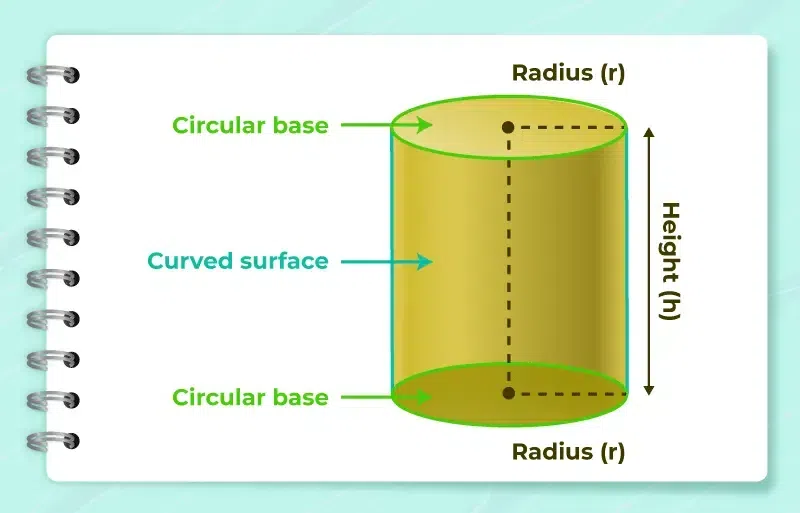
3. CYLINDER
Let radius of base = $r$ and Height (or length) = $h$. Then,
- Volume = $(\pi r^2 h)$ cubic units.
- Curved surface area = $(2\pi rh)$ sq. units.
- Total surface area = $2\pi r(h + r)$ sq. units.
4. CONE
Let radius of base = $r$ and Height = $h$. Then,
- Slant height, $l = \sqrt{h^2 + r^2}$ units.
- Volume = $\frac{1}{3}\pi r^2 h$ cubic units.
- Curved surface area = $(\pi rl)$ sq. units.
- Total surface area = $(\pi rl + \pi r^2)$ sq. units.
5. SPHERE
Let the radius of the sphere be $r$. Then,
- Volume = $\frac{4}{3}\pi r^3$ cubic units.
- Surface area = $(4\pi r^2)$ sq. units.
6. HEMISPHERE
Let the radius of a hemisphere be $r$. Then,
- Volume = $\frac{2}{3}\pi r^3$ cubic units.
- Curved surface area = $(2\pi r^2)$ sq. units.
- Total surface area = $(3\pi r^2)$ sq. units.
Note: $1 \text{ litre} = 1000 \text{ cm}^3$.