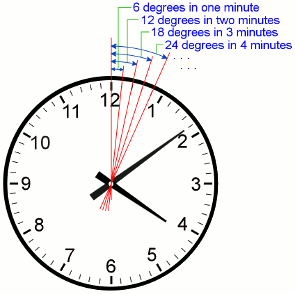
The clock face is a circle divided into 60 equal minute spaces.
Relative Speed
In 60 minutes, the minute hand gains 55 minutes over the hour hand.
Coincidence
Both hands coincide once every hour.
Straight Line
Hands are in a straight line when they are either coincident or opposite (180°).
Right Angles
When at right angles (90°), the hands are 15 minute spaces apart.
Opposite Direction
When opposite (180°), the hands are 30 minute spaces apart.
Hour Hand Angle
Angle traced by the hour hand in 12 hours = 360°. (So, $0.5^\circ$ per minute).
Minute Hand Angle
Angle traced by the minute hand in 60 minutes = 360°. (So, $6^\circ$ per minute).
Understanding Clock Errors
Too Fast: If a clock indicates 8:15 when the actual time is 8:00, it is 15 minutes fast.
Too Slow: If a clock indicates 7:45 when the actual time is 8:00, it is 15 minutes slow.
No.
Concept
Description / Formula
1
Minute Spaces
The face or dial of a watch is a circle whose circumference is divided into 60 equal parts, called minute spaces.
2
Hands
A clock has two hands: the smaller one is the hour hand (short hand) and the larger one is the minute hand (long hand).
3
Relative Gain
In 60 minutes, the minute hand gains 55 minutes on the hour hand.
4
Coincidence
In every hour, both the hands coincide once.
5
Straight Line
Hands are in a straight line when they are either coincident or opposite to each other.
6
Right Angles
When the two hands are at right angles, they are 15 minute spaces apart.
7
Opposite
When the hands are in opposite directions, they are 30 minute spaces apart.
8
Hour Hand Angle
Angle traced by hour hand in 12 hrs = 360°.
9
Minute Hand Angle
Angle traced by minute hand in 60 min. = 360°.
10
Fast Clock
If a clock indicates 8:15 when the correct time is 8:00, it is 15 minutes too fast.
11
Slow Clock
If a clock indicates 7:45 when the correct time is 8:00, it is 15 minutes too slow.
Based on the IndiaBIX Clock Formulas page, here is the data organized into a structured table:
Clock Aptitude Formulas & Facts
No.
Concept
Description / Formula
1
Minute Spaces
The face or dial of a watch is a circle whose circumference is divided into 60 equal parts, called minute spaces.
2
Hands
A clock has two hands: the smaller one is the hour hand (short hand) and the larger one is the minute hand (long hand).
3
Relative Gain
In 60 minutes, the minute hand gains 55 minutes on the hour hand.
4
Coincidence
In every hour, both the hands coincide once.
5
Straight Line
Hands are in a straight line when they are either coincident or opposite to each other.
6
Right Angles
When the two hands are at right angles, they are 15 minute spaces apart.
7
Opposite
When the hands are in opposite directions, they are 30 minute spaces apart.
8
Hour Hand Angle
Angle traced by hour hand in 12 hrs = 360°.
9
Minute Hand Angle
Angle traced by minute hand in 60 min. = 360°.
10
Fast Clock
If a clock indicates 8:15 when the correct time is 8:00, it is 15 minutes too fast.
11
Slow Clock
If a clock indicates 7:45 when the correct time is 8:00, it is 15 minutes too slow.
Note: To calculate the angle for any specific time, you can use the derived speeds: the minute hand moves at 6° per minute and the hour hand moves at 0.5° per minute.
Install app & Sign Up to start your preparation Today
Be keep up! Get the latest Exams delivered straight to your inbox.